
Room to Build: Inside Angel Fire’s Two-Summer Lift Project
New Mexico’s first six-place chairlift was load-tested in July, with months to spare. That was the plan all along.
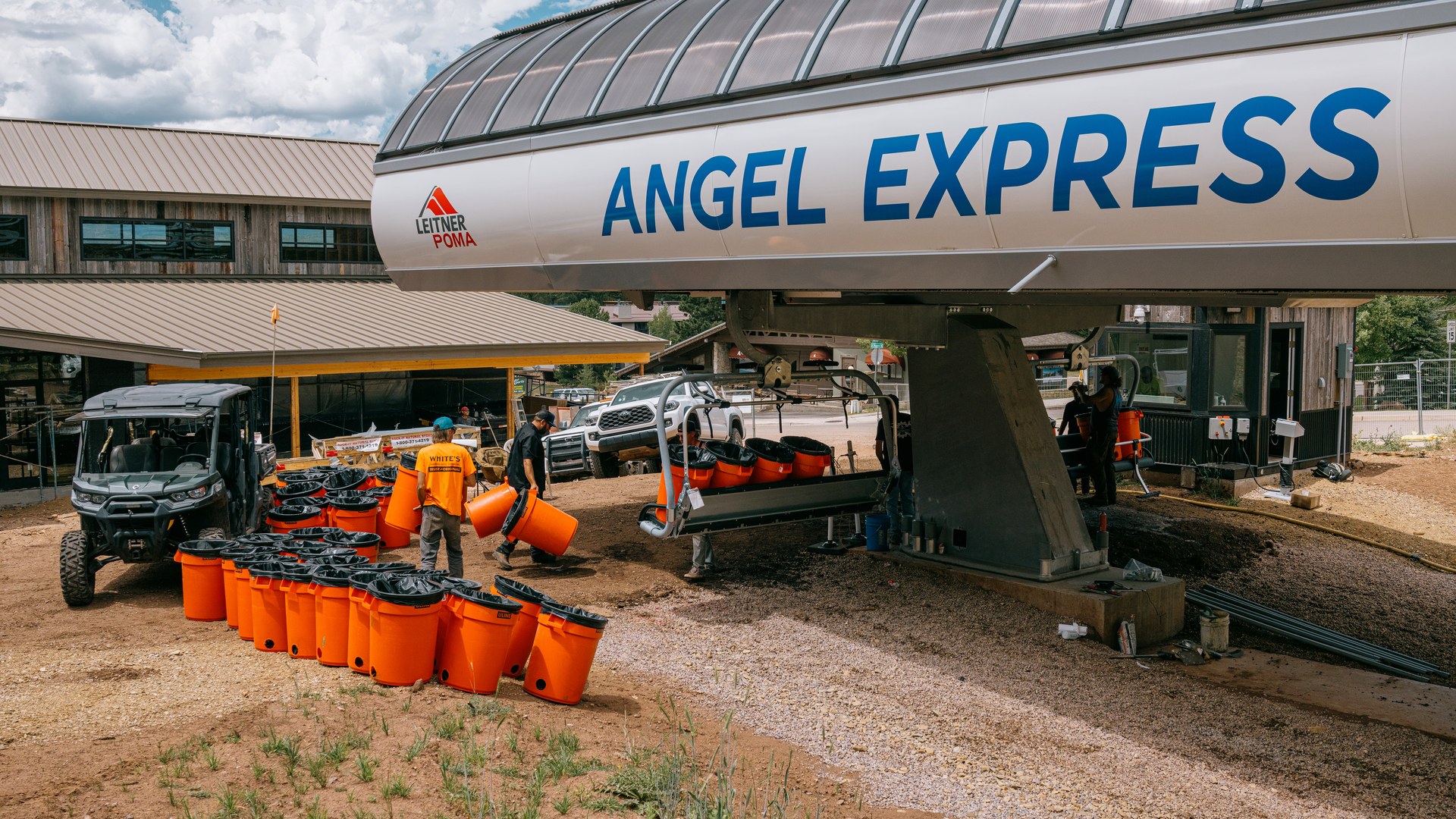
In July 2026, crews at Angel Fire Resort load-tested the Angel Express, the high-speed six-place chairlift Leitner-Poma of America recently completed on the resort’s front side. A load test in July, five months ahead of a winter opening, is a rare luxury in the ropeway world. On most new installations, that milestone arrives with winter bearing down and no slack left in the schedule.
“Having a load test in July is huge, rather than in December,” said Tucker Cottam, Angel Fire’s director of lifts.
The breathing room was deliberate. When Angel Fire committed to building New Mexico’s first detachable six-pack, the resort and LPOA structured the project as a two-summer build rather than a single-season sprint. The payoff has shown up at nearly every stage since.
The lift
The Angel Express replaces Lift 2, a fixed-grip Riblet double that had carried skiers since the resort opened in 1966. Running 5,342 feet from the base area to mid-mountain and climbing 887 vertical feet, the new lift will carry 1,800 riders per hour at 1,000 feet per minute across 15 towers and 56 chairs.
“We’re putting in the lift to bring better access to beginner and intermediate terrain,” said Maya Lengerich, director of mountain operations. “This lift goes halfway up our mountain and will give skiers a different experience. It ties in new base area development as well, and our new rental shop building.”
The one-summer problem
A single-year lift contract gives a resort one snow-free summer to do everything: clear the line, excavate, pour foundations, fly towers, splice rope, complete electrical work, test, and open by December. Weather, subsurface surprises, permitting, and parts delivery all draw from the same shrinking pool of days, and when something slips, the winter deadline doesn’t move.
Angel Fire wanted no part of that math, and the instinct came from the top. “Our CEO, John Kitts, is very much into two-year builds on other things, like facilities,” Lengerich said. “He wants to spread the payments out over a longer time frame.”
The same structure that spread the capital expenditure across two budget years also took the pressure off the mountain. “Removing the time crunch was good,” Lengerich said. “We run a bike park in summer, so by spreading it out we were able to not limit summer operations. And when things went wrong,” such as when the electrical work didn’t go according to their timeline, “it wasn’t as stressful, because we weren’t down to the wire.”
Groundwork
Crews broke ground in April 2025, taking advantage of Angel Fire’s comparatively dry climate. The first summer went to clearing, excavation, and concrete.
“If you do your concrete work the first summer, it gives you more time to clean that up, and you can spend time on the new line,” Cottam said. “Then the following summer you basically just fly steel, and you can be done a lot quicker.”
Ordering all major components within the first project year kept supply chain risk off the critical path. “The lead time to have the bigger parts here right at the beginning of construction season, rather than waiting until later, was good for us,” Lengerich said. “They were all ordered and we were able to jump on it right away.”
Meanwhile, Lift 2 kept spinning. “We were able to get all the foundations and concrete poured and still run our old lift for the season,” Cottam said. “It never impacted operations in summer or winter.”
In spring 2026, the project shifted to assembly, with tower flights, terminal construction, and, in May, the splicing of the haul rope.
Guests, meanwhile, got two years of visible progress instead of one summer of closures and apologies. “It created more excitement with our customers about a new lift coming in, and they still got to have a good winter,” Cottam said.
The case for multiyear builds
LPOA has been making the case for multiyear contracts across its project portfolio: more time for planning and permitting before construction; later excavation starts that work with ground conditions and resort operations; a buffer for subsurface and weather surprises; and second-year completions early enough to support summer and fall operations and finish supporting work around the lift. Even though Angel Fire has a relatively long building season, the resort found the two-year build to be successful on all fronts.
The Angel Express opens for the 2026–27 winter season.


