
LPOA’s Crystal Express Transforms the Anakeesta Experience
Leitner-Poma of America recently completed the total redesign and rebuild of the iconic Crystal Express at Anakeesta Mountaintop Adventure Park in Gatlinburg, Tenn., bringing the adventure park’s lift capacity in line with its current visitor numbers.
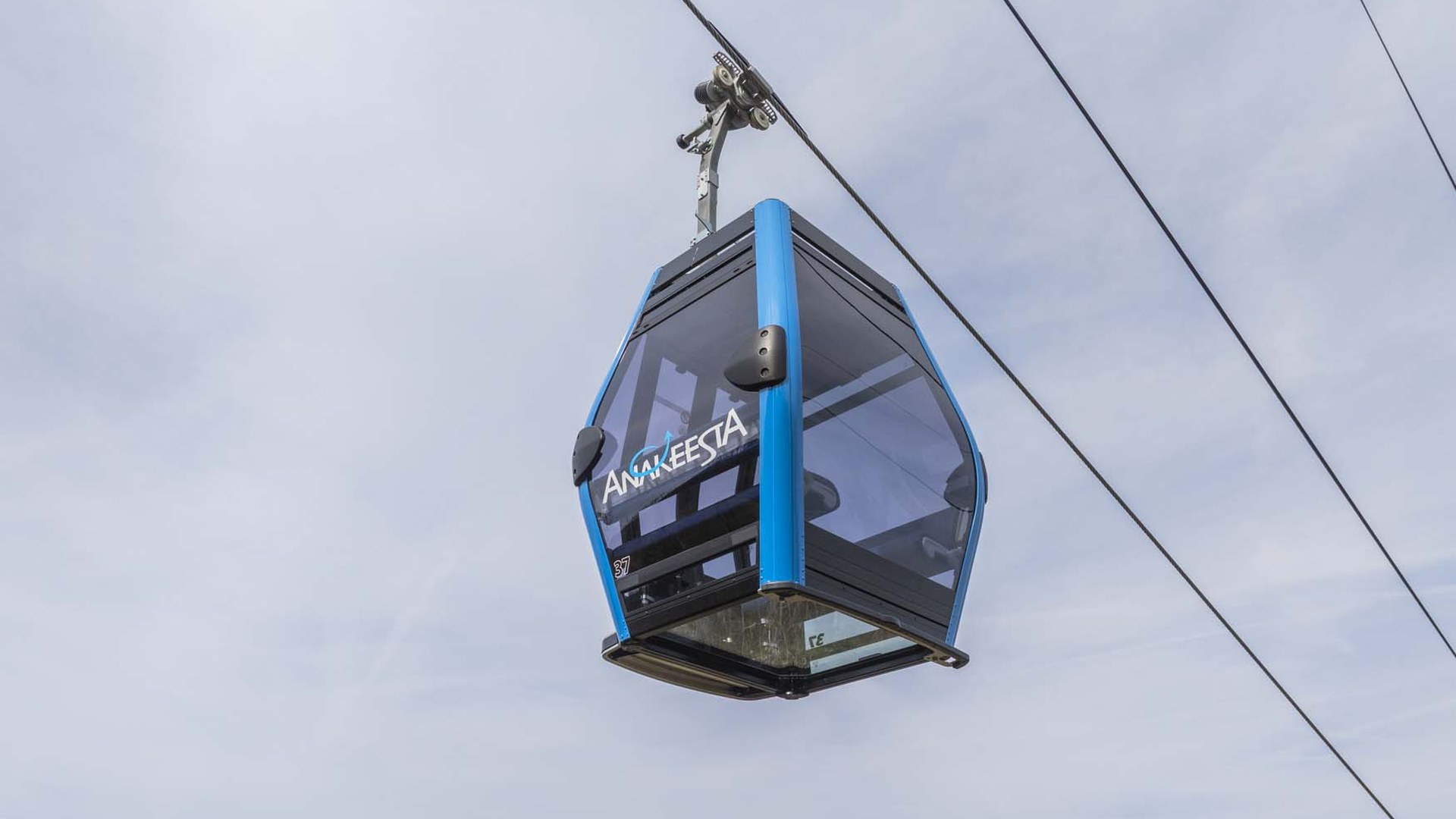
LPOA is proud to announce the opening of one of North America’s first gondolas with fully glass-floored cabins, the Crystal Express, at Anakeesta Mountaintop Adventure Park in Gatlinburg, Tenn. The new gondola dramatically improves the visitor experience and supports Anakeesta’s current traffic. This unique project was a complete redesign and rebuild of the original LPOA lift and is the latest in LPOA’s adventure park portfolio.
In 2017, LPOA installed the first lift at Anakeesta, a telemix with both chairs and gondola cabins and a ride time of 20 minutes. Since then, Anakeesta has grown in both size and popularity, necessitating a new transportation system with higher speed and capacity. The new six-place gondola, which debuted at Anakeesta’s grand opening on May 22, cut the ride time to just over four minutes. The new gondola is one of the first in North America to feature a full-glass floor in every cabin—others in existence feature only partial-glass floors—offering visitors 360-degree views of the Smoky Mountains and downtown Gatlinburg as they soar up to the summit of the park.
On-time completion of this project was particularly impressive because there were a number of unique challenges that LPOA had to surmount. First, the timeline was accelerated because, unlike ski areas that close in the summer, Anakeesta operates as a year-round adventure park, which meant LPOA’s installation team had a limited window—from January to May—between the park’s busy months in which to get the heavy work done.
“We’re not seasonal—we’re open 340 days a year, and a longer shutdown wasn’t an option,” said Sherilyn Hammonds, director of development at Anakeesta. “The gondola is our lifeline; it’s the only way for guests to get up and down.”
The construction of the bottom station was another huge undertaking because it needed to happen within an existing open-air building that LPOA could not remove. “The existing building was built around our old lift. It’s a very large and elaborate glue-lam and steel structure,” said Hammonds. “And there are stone pillars that hold up the roof, and they couldn’t be moved.” The cabins of the new gondola also had to pass through the original building’s exit, which dictated their size.
To work around the building, LPOA’s team had to first assemble the lift terminal on the ground, rather than vertically, using an all-terrain forklift. “That required some creative problem-solving,” said Nic Jolly, installation site manager. Once it was assembled, the team used a crane on one end and a truck lifter on the other to lift the terminal in one complete unit and set it on the foundation. “We had about 6 inches from the top of the crane to the roof of the building inside,” said Jolly. “To get this thing in place took a lot of head scratching.”
Then there was the issue of how to transport all the large equipment to the top of the mountain, because the team only had access to one tight, winding road with a low pedestrian bridge that crossed it near the top. They removed and replaced the existing line with a Black Hawk helicopter and used a remote-controlled Goldhofer self-propelled trailer, which is low in height, to get equipment up and down. When it came time to bring up the operator enclosure, they had to tilt it over to squeeze it through, barely clearing the bridge.
The summit, too, was a challenge in terms of having very limited space in which to work and set equipment. In addition, the park was also building a 28-foot retaining wall and making other infrastructure changes. “We had dump trucks, excavators, cranes, mechanics, and electricians all in this bottleneck of a tiny turnaround,” Jolly said. “If you look at it on Google Maps, you’d think, ‘Wow, how’d they get all this stuff up there?’”
In addition to the logistics, the brief winter window in which the installation team had to work to retain park staff and protect revenue came with another set of challenges. Most lift installations happen in summer, with temperatures that are ideal for curing concrete. For this project, the team was pouring it in 10-degree weather, Jolly said. “We had to get insulated concrete blankets, and we blew hot air with diesel heaters into makeshift tents in order for the concrete to cure at a regulated rate. I was going up there at 2 and 3 in the morning to refill the generators and diesel heaters to keep our concrete warm.”
The LPOA team also had to work with as much existing infrastructure as possible, as the client wanted to reuse as much as possible. They removed and added towers and removed the old mid-station to create the finished product: 12 towers, a slope length of 2,123 feet, 56 glass-floored cabins, and a capacity of 2,100 people per hour. “They did wrap a few cabins for the wary customers who don’t want to see what’s below them,” Jolly said.
The Anakeesta project marks LPOA’s third adventure park installation in as many years. LPOA completed the Minifigure Skyflyer at LEGOLAND New York Resort, the first LPOA lift at any LEGOLAND park worldwide, in the spring of 2024, and the Saluda Skyride at Riverbanks Zoo and Garden in Columbia, S.C., in 2025. As more attractions seek innovative and unique transportation solutions, LPOA is positioned at the forefront of this evolving market.
“We’re thrilled to continue working in the adventure park space,” said Michael Manley, director of sales at LPOA. “We see so much opportunity there for LPOA to improve guest experience and transform transportation into an adventure in and of itself.”


